At the end of The Subtle Knife, In the section titled Lantern Slides Philip Pullman writes:
“A dæmon is not an animal, of course; a dæmon is a person. A real cat, face to face with a dæmon in cat form, would not be puzzled for a moment. She would see a human being” (Pullman 538).
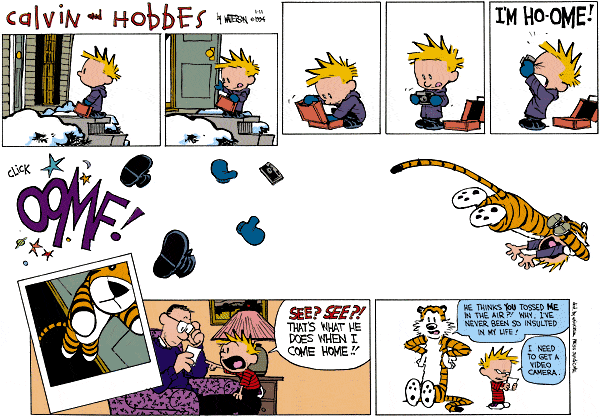
What interests me most about this passage is, that with this statement, Pullman implies one of two things regarding humanity: Either the “real cat” mentioned in the passage simply recognizes dæmons as one shape-shifting half of what makes up humans, or that there’s something uniquely ethereal about humans. Based on my experience reading Pullman thus far, I’d be willing to bet on the latter. However, another, somewhat different interpretation calls to mind the character Calvin, of Bill Watterson’s comic strip, Calvin and Hobbes. In his comic, Watterson frequently shifts the reader’s perspective to just outside Calvin’s imagination, to that of his parents’ or some other character, to suggest that maybe Hobbes, Calvin’s tiger companion, may be no more than a plain stuffed toy. And yet, by never fully delving into the topic of what is and isn’t real, much like Pullman, Watterson is able to use Hobbes as a separate entity from Calvin, reflecting his personality as much as any dæmon in His Dark Materials. By asking whether Calvin simply threw Hobbes into the air, or was actually tackled by an anthropomorphic pet tiger, invisible to everyone but him, poses the question: Are humans in His Dark Materials Calvin, his parents, or Hobbes?

 Reading Young Adult Literature
Leave a comment